Monitor livestock presence without daily drives
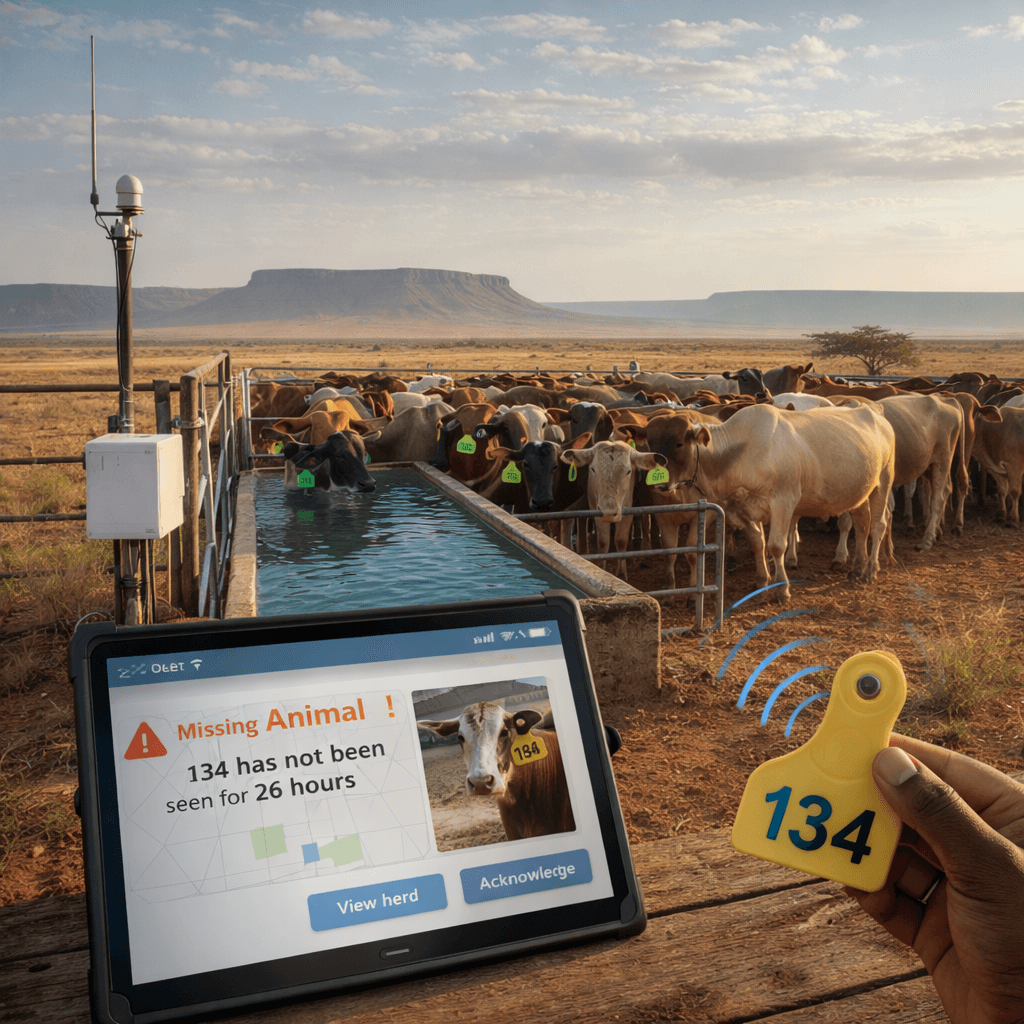
Long-range UHF RFID at water troughs helps you confirm that cattle are visiting critical water points, with alerts when animals have not been detected for a defined period.
Built for remote farms with intermittent connectivity, solar power, and rugged hardware rated for dust, heat, and rain.
The problem
On large Southern African properties, water points can be dozens of kilometers apart. A missing animal can go unnoticed for days if teams only inspect troughs on a rotating schedule. By the time staff arrive, a dehydrated animal may already be down, and predators can take advantage of the situation.
Farm managers are under pressure to do more with fewer people. Skilled workers are stretched across fencing repairs, vehicle servicing, and long-distance herding. Each extra drive to confirm herd presence consumes fuel, labor hours, and vehicle wear. It also takes attention away from higher-value tasks like breeding programs and pasture planning.
Traditional visual checks are useful, but they are not reliable in rough terrain or dense bush. When drought conditions intensify, animals may range further, and water usage patterns become more erratic. Farmers need a dependable, low-cost signal that tells them which animals have definitely visited a water point, and which have not.
How it works
- UHF RFID readers are mounted at troughs or walk-through points to capture ear tag sticker IDs.
- Each detection event is time-stamped and linked to a specific water point and camp.
- Events flow to a solar-powered IoT gateway via wired link or low-power radio, depending on layout.
- The gateway buffers data locally, applies basic rules, and forwards batches when cellular backhaul is available.
- The dashboard updates herd presence, showing last-seen times and missing-animal lists.
- Alerts are triggered when an animal or a herd group has not been detected within a defined window.
Missing-animal rules are configurable, for example 12 hours for calves, 48 hours for mature cattle, or herd-level averages by camp. This helps managers focus on exceptions without alarming workers for normal movement patterns.
Hardware on the farm
- UHF RFID readers with directional antennas mounted at water points to capture tag IDs as cattle drink.
- RFID sticker tags applied to existing ear tags, with a practical replacement process for lost or damaged tags.
- Solar-powered IoT gateway that aggregates detections and handles store-and-forward sync.
- LoRaWAN nodes where needed to bridge remote troughs back to the gateway without heavy cabling.
- Optional LoRaWAN beacon or collar tags for higher-fidelity movement insights beyond water points.
Technical details
LoRaWAN connectivity
LoRaWAN is a long-range, low-power radio network well suited to large farms. Range varies with terrain, vegetation, and antenna height, so a site survey is recommended. We typically deploy a private on-farm network for reliability, with cellular backhaul only at the gateway.
IoT gateway behavior
The gateway buffers events on the edge, retries uploads when the network is unstable, and supports scheduled firmware updates. This keeps your system stable even when connectivity drops for hours or days.
Power and durability
Hardware is designed for solar operation with battery backup. Enclosures are rugged and weather resistant, suitable for dusty, hot, and wet environments common across Southern Africa.
Offline-first sync
If the farm loses cellular service, data continues to collect locally. Once coverage returns, the gateway syncs events in order so your reports and alerts remain accurate.
Security basics
Each device has a unique identity. Data is encrypted in transit, and the platform uses role-based access to control what owners, managers, and workers can see.
Key benefits
- Reduce losses by identifying missing cattle within hours instead of days.
- Cut vehicle kilometers by focusing inspections on flagged camps.
- Improve animal welfare with faster response to dehydration or injury.
- Support audit readiness with a clear last-seen history per animal.
- Detect abnormal herd behavior at specific troughs during drought stress.
- Scale to multiple farms without adding full-time staff.
- Maintain visibility even when cellular coverage is intermittent.
- Lower operational risk with consistent presence reporting.
Use cases in Southern Africa
A Namibian cattle ranch uses RFID at borehole troughs to flag animals not seen for 48 hours, prioritizing checks for high-value breeding stock.
A Botswana ranch with widely spaced camps sets herd-level rules so the manager only drives to camps where the average time-since-visit exceeds a threshold.
A South African mixed farm tracks young heifers separately, making sure they are using designated troughs during heat waves.
A Zambian operation layers optional LoRaWAN beacon collars on a small subset of animals to validate grazing movement in conservation areas.
What you see in the app
The dashboard highlights the last-seen time for each animal, with filters for camp, herd group, and water point. A map view shows trough status and recent detections. Alerts appear in a timeline with clear actions for managers and workers, and every alert is logged with an audit trail. Photos or notes can be attached to follow-up actions, so the owner can see what was done and when.
FAQ
How far can the RFID readers detect tags at water points?
Read range depends on antenna placement, tag orientation, and animal behavior. Typical trough setups see consistent reads within a few meters. We tune antenna angles per site and recommend a short on-site survey to confirm reliable coverage.
How long do RFID sticker tags last on ear tags?
Sticker tags are designed for outdoor use but can be damaged by rubbing, mud, or UV exposure. We recommend placement on clean ear tags, periodic inspections during normal handling, and a simple replacement workflow for lost tags.
What happens if there is no cellular coverage?
The gateway stores events locally and forwards them when signal returns. Alerts are queued and delivered in order, so you still get a clear audit trail of when animals were last seen.
How many animals can the system handle?
The platform scales by adding readers and gateways. Herd size is limited by on-farm hardware layout rather than software, and we can segment by camps and water points for clarity.
Can I mix RFID with other tracking methods?
Yes. RFID at troughs is a low-cost presence signal. For higher fidelity, you can optionally add LoRaWAN beacon tags or collar devices for additional locations and movement insight.
How fast is installation?
Most water-point installs take a few hours, including antenna alignment and commissioning. Larger farms usually phase deployment to validate coverage before rolling out more sites.
Do you support multiple farms or leases?
Yes. You can manage multiple properties, camps, and owner accounts with role-based access and audit trails per site.
How is pricing structured?
Pricing is based on the number of sites and devices, plus a software subscription. We avoid fixed per-animal fees so large herds remain economical.
Ready to see it on your farm?
Book a demo to map your sites, or get started to set up your first location.