Monitor water levels across tanks, dams, and boreholes
Know your reservoir status at a glance, receive early warnings for leaks or pump failures, and keep stock supplied without constant driving.
Engineered for remote water infrastructure with low-power sensors, solar gateways, and offline-first data handling.
The problem
Water is the lifeline of large-scale livestock operations, yet most farms still rely on manual checks. In dry seasons, a single missed visit to a trough can lead to dehydration, weight loss, and costly emergency callouts. When reservoirs are far apart, staff can spend entire days driving just to confirm that pumps are running.
Boreholes and solar pumps are critical assets, but they are vulnerable to wear, silt, and power failures. A pump that stops overnight can empty a tank by morning. Without timely information, managers only learn of the problem when cattle are already waiting at a dry trough.
Water systems also face theft and vandalism risks. Pipes can be cut, valves left open, and storage tanks drained. A reliable, automated signal that shows level trends and abnormal drops saves time and protects both livestock and infrastructure.
How it works
- Sensors measure water levels or flow at tanks, dams, boreholes, and troughs.
- Readings are sent via LoRaWAN to a nearby gateway, or wired directly for close sites.
- The gateway buffers data, applies basic thresholds, and forwards batches when cellular signal is available.
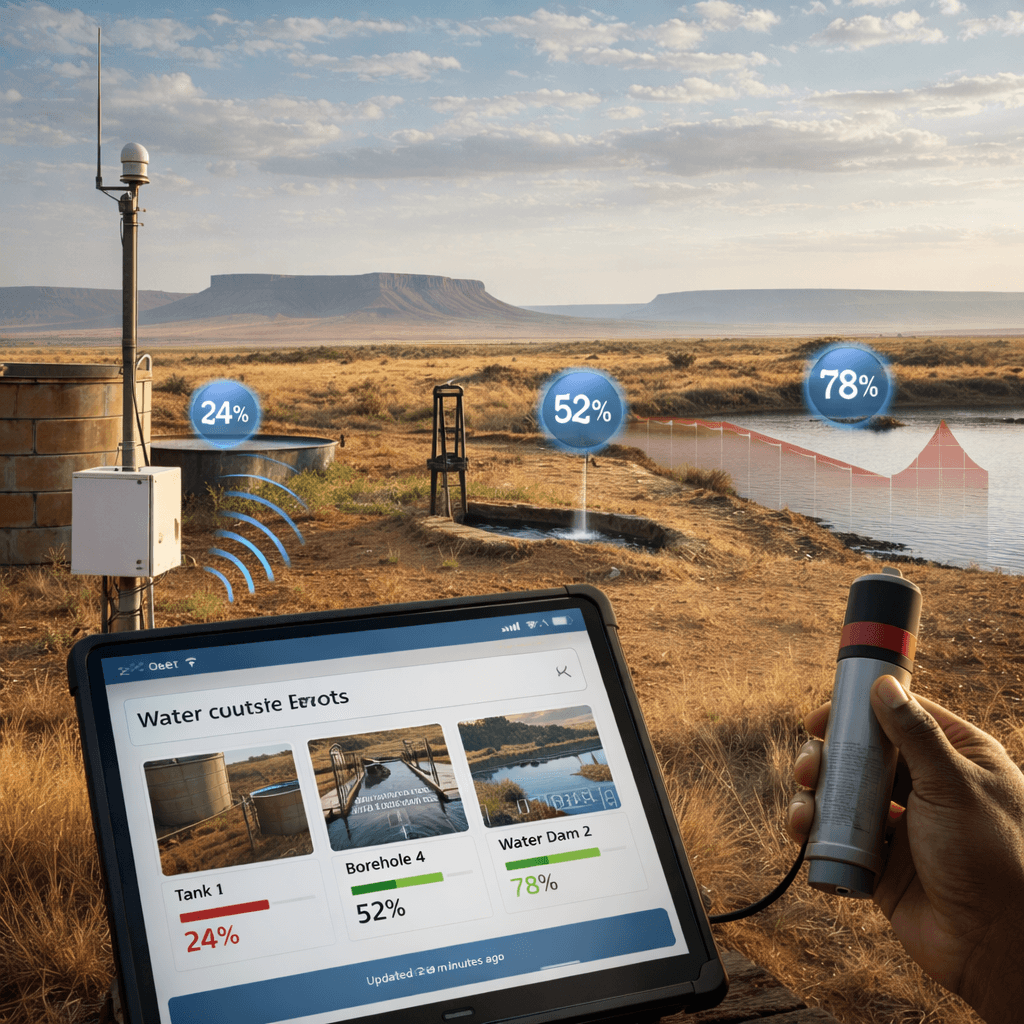
- The dashboard visualizes levels, trends, and pump activity per site and per camp.
- Alerts trigger for low thresholds, rapid drops, or abnormal pump behavior.
- Managers assign follow-up tasks or schedule maintenance before stock is affected.
Hardware on the farm
- Solar-powered IoT gateway that manages data collection and store-and-forward sync.
- LoRaWAN sensor nodes for low-power, long-range connections across large properties.
- Pressure transducers for accurate depth readings in tanks and boreholes.
- Ultrasonic sensors for non-contact monitoring of open dams and reservoirs.
- Float switches for simple high/low threshold alerts in troughs or small tanks.
- Flow meters to track usage and detect abnormal consumption or pipe bursts.
- Pump runtime or energy monitoring to identify failing motors or solar issues.
Technical details
LoRaWAN connectivity
LoRaWAN provides long-range coverage with low power usage, ideal for water sites spread across multiple camps. Range varies with terrain and vegetation, so antenna height and placement are critical. We typically deploy a private farm network for reliability, with cellular backhaul only at the gateway.
IoT gateway behavior
The gateway buffers readings when connectivity drops and retries uploads automatically. Firmware updates can be scheduled to avoid disruption, and local rules allow critical thresholds to be evaluated on-site.
Power and durability
Sensor nodes are designed for low power draw and can run for years on battery or solar. Enclosures are rugged, weather resistant, and built for dust, heat, and rain.
Offline-first sync
If cellular coverage is down, data continues to collect and store locally. Once the gateway reconnects, data syncs in order so trend analytics remain accurate.
Security basics
Each device uses secure identities and encrypted links. Role-based access ensures only authorized managers can change alert rules or download reports.
Key benefits
- Reduce emergency callouts by spotting low levels before troughs run dry.
- Cut fuel and vehicle wear by prioritizing water points that need attention.
- Detect leaks, pipe bursts, or valve failures early through rapid-drop alerts.
- Improve pump reliability with runtime and energy monitoring.
- Plan refills using trend analytics and forecasted consumption.
- Support drought management by understanding usage per camp.
- Improve staff productivity with clear, prioritized alerts.
- Build a traceable record for compliance and insurance reporting.
Use cases in Southern Africa
A Botswana cattle operation monitors lined reservoirs and uses rapid drop alerts to catch pipe failures caused by wildlife.
A Namibian mixed farm tracks borehole pump runtime to identify aging motors before peak summer demand.
A South African irrigation block combines flow meters with level sensors to verify that water rights are used efficiently.
A Zambian ranch monitors trough levels across multiple camps, using forecasted refill times to schedule tanker deliveries.
What you see in the app
The app shows dashboard tiles for each reservoir with current level, trend arrow, and last update time. A map view displays tanks, dams, boreholes, and troughs by camp. Alerts appear in a timeline with clear severity flags, and managers can assign follow-ups to workers. Reports summarize pump performance, usage per camp, and refill forecasting, with an audit trail of actions taken.
FAQ
Which reservoir types can be monitored?
We support tanks, earth dams, lined reservoirs, boreholes, and troughs. The sensor choice depends on depth, access, and whether the site is exposed to wildlife or debris.
How accurate are the sensors?
Accuracy depends on sensor type and installation. Pressure transducers provide consistent depth readings, ultrasonic sensors avoid contact with water, and float switches give reliable level thresholds. We confirm expected accuracy during site setup.
What happens if a sensor fails?
The platform flags missing data and notifies the manager. Because each sensor has a health heartbeat, you can see if the issue is power, connectivity, or hardware.
Can I detect leaks or pipe bursts?
Yes. Rapid drop alerts and abnormal flow patterns highlight potential leaks, broken pipes, or stuck valves so teams can respond quickly.
How do you handle no cellular coverage?
The gateway stores readings locally and syncs when signal returns. Critical alerts can also be routed through local radio or SMS where available.
Is a site survey required?
We recommend a short survey to confirm radio range and determine sensor placement, especially in hilly terrain or where vegetation blocks line of sight.
How is pricing structured?
Pricing is based on the number of monitored points and devices, with a predictable software subscription for data and dashboards.
Can I manage multiple farms?
Yes. The dashboard supports multiple properties with role-based access and separate reporting per farm or camp.
Ready to see it on your farm?
Book a demo to map your sites, or get started to set up your first location.