Optimize farm operations with connected workflows
Assign tasks, verify completion, and connect sensor events to actions so teams respond quickly across large, remote properties.
Built for intermittent connectivity, rugged field use, and multi-team operations across Southern Africa.
The problem
Large farms are run through hundreds of small tasks: checking water points, repairing fences, moving stock, servicing vehicles, and managing feed. Without a clear system, work can be duplicated or forgotten, especially when teams are spread across distant camps.
Managers often rely on radio calls or paper notes that cannot be verified later. This makes it difficult to confirm whether a pump was checked, if a gate was repaired, or when a vaccine batch was administered. Inconsistent reporting reduces accountability and increases risk.
Seasonal labor adds complexity. Contractors may work across multiple farms, and owners still need proof that safety checks and compliance tasks were completed. Clear workflows reduce disputes and help ensure that critical actions are done on time.
Connectivity is unreliable, so any workflow system must function offline and sync later. It should also be simple enough for teams who are working in dusty, hot, and remote conditions where devices and network access are limited.
How it works
- Managers create task templates, checklists, and recurring schedules per camp.
- Tasks are assigned to workers or teams with due dates and priority.
- Workers complete tasks offline and attach proof-of-work such as photos or GPS location.
- Automation rules connect sensor events to new tasks or alerts.
- The gateway and app sync progress when connectivity returns.
- Reports summarize completion rates, labor hours, and compliance trends.
Hardware on the farm
- Rugged smartphones or tablets for field teams to complete tasks and capture photos.
- Solar-powered IoT gateway that syncs data from remote camps.
- LoRaWAN nodes that link sensor events (water, gates, pumps) to workflow automation.
- Optional RFID or barcode scanners for stock or inventory related tasks.
Technical details
LoRaWAN connectivity
LoRaWAN connects low-power sensors to the workflow system, enabling automation even in large, remote camps. Range varies with terrain, so a short site survey helps confirm coverage and antenna placement.
IoT gateway behavior
The gateway buffers task updates and sensor events, then syncs when cellular backhaul is available. This ensures tasks stay reliable when teams are offline for long periods.
Power and durability
Devices and enclosures are chosen for low power draw and field durability. Solar-ready power keeps workflows running when the grid is unreliable.
Offline-first sync
Task lists and checklists are cached on-device. When staff reconnect, updates sync with a reliable audit trail so managers can see accurate completion times.
Security basics
Each user has role-based access, and actions are logged. Data is encrypted in transit to protect operational details.
Key benefits
- Reduce missed checks with recurring task schedules.
- Improve accountability through proof-of-work attachments.
- Respond faster to sensor-triggered issues like low water or open gates.
- Standardize work quality with checklists and task templates.
- Cut travel time by assigning tasks based on real-time alerts.
- Track labor hours and completion rates for better planning.
- Support compliance with auditable task histories.
- Scale operations without increasing supervision overhead.
Use cases in Southern Africa
A South African cattle farm assigns weekly fence patrols with photo proof for each section of boundary fencing.
A Namibian ranch links water level alerts to automated pump inspection tasks, reducing dry-trough incidents.
A Botswana operation uses recurring dip tank checklists to ensure seasonal compliance and accurate chemical dosing.
A Zambian mixed farm tracks harvest labor, recording completion rates and hours per block to improve planning.
What you see in the app
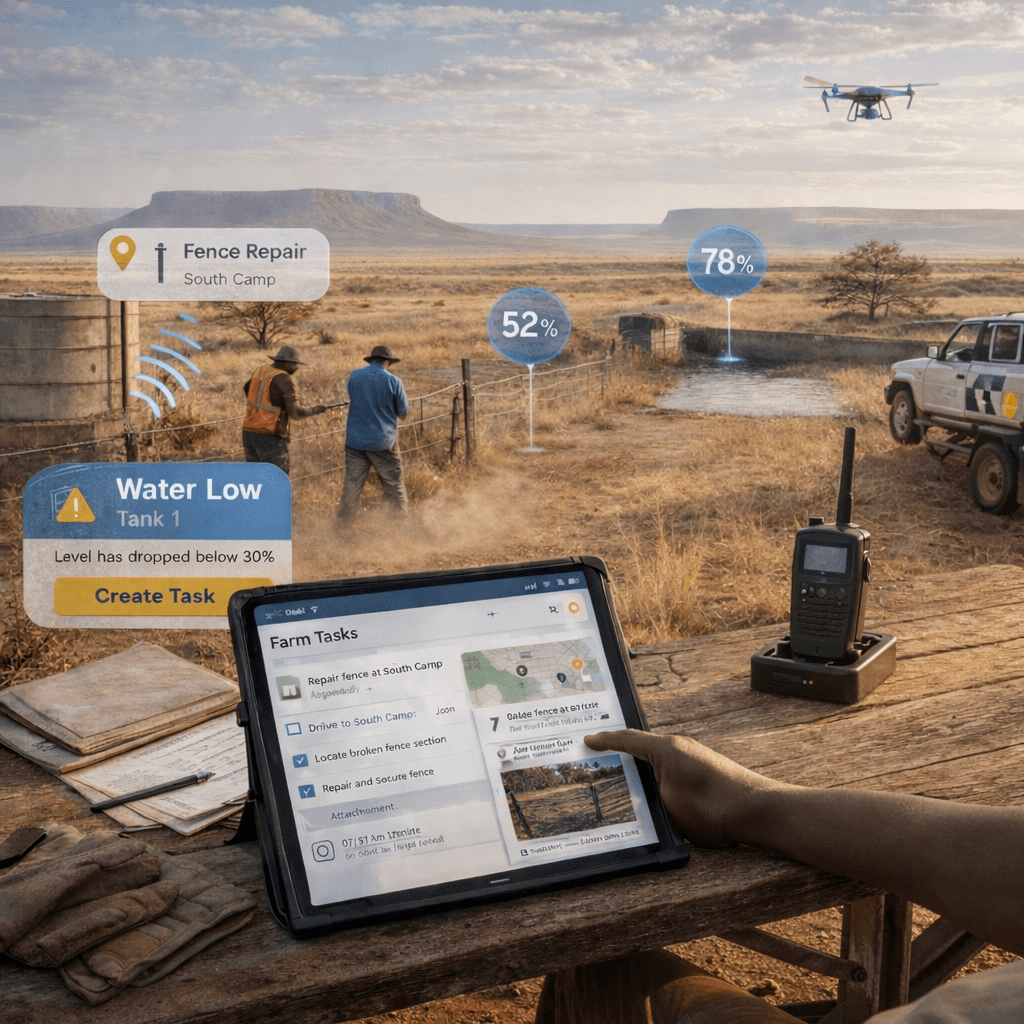
The workflow dashboard displays active tasks, overdue items, and completion rates by team. Managers can filter by camp or task type, review photo attachments, and verify timestamps. An alert timeline connects sensor events to tasks, and reports summarize labor hours, compliance, and recurring task success. Owners, managers, and workers see only the views relevant to their roles, with a full audit trail behind the scenes.
FAQ
Can workers use the system on basic phones?
The primary workflow app runs on smartphones or rugged tablets. For areas with limited device access, managers can print task lists or share summaries via SMS where connectivity allows.
What counts as proof-of-work?
Photos, time stamps, GPS location, and notes can be attached to completed tasks. This provides accountability without slowing staff down.
How do automation rules work?
Rules connect sensor events to tasks or alerts. For example, a low water reading can automatically generate a pump check task and notify the responsible team.
Does it work offline?
Yes. Task lists and checklists are available offline and sync when the device reconnects, preserving completion times and attachments.
How do you report labor time?
Completion logs and optional time tracking provide summaries of labor hours by camp, task type, and team.
Can I manage multiple farms?
Yes. You can segment workflows by farm, camp, or enterprise, with role-based permissions for each team.
Is there an audit trail for compliance?
Every task update is logged, including who completed the work and when, which helps with compliance and quality control.
How is pricing structured?
Pricing is based on the number of users and the complexity of workflows, with predictable subscription tiers.
Ready to see it on your farm?
Book a demo to map your sites, or get started to set up your first location.